Guide
Gas & payers
An EIP-8130 transaction can name a payer: a second account that co-signs and pays gas. The sender authorizes the calls (sender_auth); the payer authorizes paying (payer_auth). This is the native mechanism behind sponsorship and pay-with-token, no bundler or EntryPoint.
Co-sign locally
When you hold the payer key (self-sponsor or your own backend), pass a payer signer to sendTransaction (or sendTransactionSync to await the receipt). It signs payer_auth bound to the sender and sets the payer wire field. Set payer.address when the onchain payer account differs from the signing key.
import { privateKeyToAccount } from 'viem/accounts'import { sendTransaction, sendTransactionSync } from 'viem/eip8130'
const sponsor = privateKeyToAccount(process.env.SPONSOR_KEY as `0x${string}`)
// Fire-and-forget: returns the transaction hash.const hash = await sendTransaction(client, {  account,                     // signs sender_auth  calls: [{ to: recipient, data }],  gas: 250_000n,  payer: { account: sponsor }, // signs payer_auth, pays the fee})
// Or wait for the receipt in a single round-trip (EIP-7966):const receipt = await sendTransactionSync(client, {  account,  calls: [{ to: recipient, data }],  gas: 250_000n,  payer: { account: sponsor },})
Whether a key may pay depends on its scope: actorScope.selfPayer funds the account's own transactions, while actorScope.sponsorPayer funds others. The distinction and its risk model live in Gas & payers (protocol).
Estimating a sponsored transaction
Pass the payer address (and payerAuthAuthenticator if the payer uses a non-K1 key) so the node prices the payer authentication too. The node prices auth gas from the blob's shape, never a real signature. For a policy-gated actor (session key) also pass senderActorId (and senderAuthAuthenticator) so estimation resolves the intended acting actor rather than the account's self-actor.
import { canonicalAuthenticators, estimateGas } from 'viem/eip8130'
const gas = await estimateGas(client, {  sender: account.address,  calls: [[{ to: recipient, data }]],  payer: sponsor.address,  // Auth-blob hints (shape only, no signing). Pass a non-K1 authenticator  // when the payer or the acting actor doesn't use the default K1 key.  payerAuthAuthenticator: canonicalAuthenticators.k1,  // Optional actor hint so the node prices the intended acting actor:  // senderActorId, senderAuthAuthenticator: canonicalAuthenticators.p256,})
Pay with a token
To charge the sender in an ERC-20 (e.g. USDV) while the payer fronts native gas, run a two-phase transaction: phase 0 transfers the token to the payer, phase 1 runs the user's calls. The payer co-signs because it can see its fee is paid in phase 0.
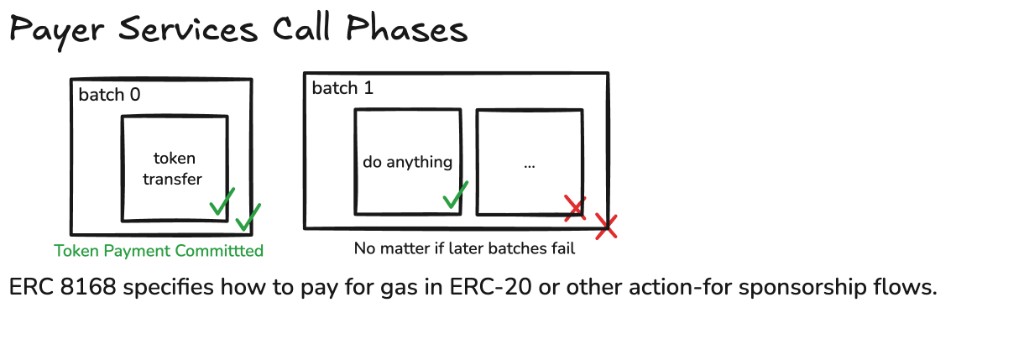
import { encodeTokenTransfer } from 'viem/eip8168'import { sendTransaction } from 'viem/eip8130'
const hash = await sendTransaction(client, {  account,  calls: [    // phase 0: pay the payer in the token    [encodeTokenTransfer({ token, to: sponsor.address, amount: fee })],    // phase 1: the actual calls    [{ to: recipient, data }],  ],  gas: 300_000n,  payer: { account: sponsor },})
Payer services (ERC-8168)
When a service holds the payer key, ERC-8168 standardizes a payer_* JSON-RPC endpoint the wallet queries to sponsor a transaction or accept a token as gas. Viem exposes the client and helpers under viem/eip8168, with two integration styles. Standalone: createPayerClient({ url }) plus sendSponsoredCalls, which fetches terms, selects an offer, and builds phases (including any phase-0 token transfer). Or decorate the client with client.extend(eip8168Actions({ payerClient })) to get client.payer.prepareTransactionRequest, client.payer.sendTransaction, and client.payer.sendTransactionSync. On Vibenet the default mode: 'send' co-signs and broadcasts; pass mode: 'sign' if you want to submit the co-signed tx yourself on https://rpc.vibes.base.org.
import { createPayerClient, sendSponsoredCalls } from 'viem/eip8168'
// Vibenet: payer co-signs and broadcasts (default mode: 'send')const payerClient = createPayerClient({  url: 'https://vibes.base.org/api/vibenet/account/payer',})
const { transactionHash: hash } = await sendSponsoredCalls(client, {  account,       // signs sender_auth; payer_auth is filled by the service  payerClient,  // mode defaults to 'send' — payer submits  // mode: 'sign'  // optional: co-sign only, then eth_sendRawTransaction yourself  calls: [{ to: recipient, data }],  gas: 2_000_000n,  context: { flow: 'transact' },  // token,     // omit to prefer a fully-sponsored offer})
By default viem estimates gas from your own node (gasEstimator: 'self') and, when the payer also returns a quote, uses max(ourEstimate, payerQuote): a payer only adds work (e.g. a token-payment phase), so a larger payer quote is safe headroom rather than an under-size. Pass gasEstimator: 'payer' on the decorator's client.payer.sendTransaction to instead trust the payer service's quote outright as the oracle. Query standing allowances with payerClient.getSponsorshipBalance before you build.
If the payer rejects with a recoverable reason (a higher token charge or gas limit), sendSponsoredCalls re-signs only when you approve each attempt via confirmRetry.
import { formatUnits } from 'viem'import { sendSponsoredCalls } from 'viem/eip8168'
const { transactionHash: hash } = await sendSponsoredCalls(client, {  account,  payerClient,  // mode defaults to 'send'  calls: [{ to: recipient, data }],  token,  retries: 2,  // Each retry mints a NEW sender_auth (and a fresh passkey gesture),  // so nothing is re-signed without explicit approval.  confirmRetry: async (request) => {    if (request.kind === 'requote')      return confirm(`Pay ${formatUnits(request.paymentAmount, 6)} in token?`)    return confirm(`Raise gas limit to ${request.gasLimit}?`)  },})
For full control, drive the primitives directly: payerClient.getTerms, selectPaymentOption, buildSponsoredCalls, then prepare, sign, and payerClient.sendTransaction (or payerClient.signTransaction + your own eth_sendRawTransaction). Decode rejections with parsePayerError.
Session keys and gas
- A
actorScope.policy-only session key cannot touch account ETH; sponsor it, or route it through a payer service that accepts spend-limit gas. - Adding
actorScope.selfPayerlets a session key self-fund gas, but a griefing key could then burn the balance on fees. Treat it as a deliberate opt-in. See Session keys.