Guide
Session keys
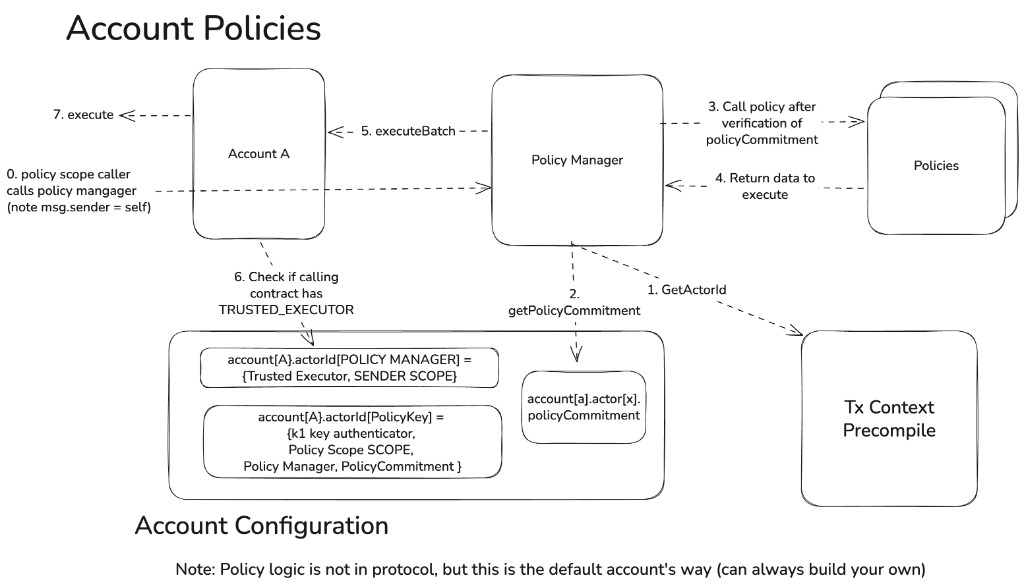
A session key is a policy-gated actor: a key authorized with a restricted scope and a policy commitment. The protocol forces every call it makes onto a PolicyManager, which enforces spend limits and allowlists, then drives the account. Hand out a scoped key without granting ownership.
The flow
- Create a smart account (sponsored create bumps the local config sequence to
1). - Author + bind a
SessionPolicywithdefineSessionPolicy. - Authorize the PolicyManager as a K1 operational actor (
key.k1(manager)) and the session key in one signed actor change on the local channel, at the live sequence. No install step. - Use the key via
PolicyManager.execute(binding, action). Declare scope only at authorize; do not redeclare it on the session account handle.
Author + bind
import { parseUnits } from 'viem'import {  defineSessionPolicy,  encodeSessionPolicyConfig,  getEip8130Deployment,} from 'viem/eip8130'
const deployment = getEip8130Deployment(client.chain.id)!const { policies } = deployment
const session = defineSessionPolicy({  account: account.address,  policy: policies.sessionPolicy,  manager: policies.manager,  validUntil: BigInt(Math.floor(Date.now() / 1000) + 30 * 86_400),  policyConfig: encodeSessionPolicyConfig({    // ≤ 100 USDC per week.    tokenLimits: [      { token: usdc, limit: parseUnits('100', 6), period: 7n * 86_400n },    ],    // Only transfer(address,uint256) on the USDC contract.    callScopes: [      { target: usdc, selectorRules: [{ selector: '0xa9059cbb' }] },    ],  }),})
session.commitment   // the policy commitment stored on the actorsession.actorPolicy  // pass to authorizeActor(key, { scope, policy })session.executeCall  // build a gated call to send at execute time// No install — the full PolicyBinding is passed at execute time.
Selector rules may bind recipients for the standard ERC-20 selectors (transfer, transferFrom, approve):
import { encodeSessionPolicyConfig } from 'viem/eip8130'
encodeSessionPolicyConfig({ callScopes: [ { target: usdc, // recipients bind the standard ERC-20 selectors (transfer/transferFrom/approve). selectorRules: [{ selector: '0xa9059cbb', recipients: [payroll] }], }, ],})import { parseEther, zeroAddress } from 'viem'import { encodeSessionPolicyConfig } from 'viem/eip8130'
// Native ETH is fail-closed: a key can move ETH (value > 0) only with a// zero-address tokenLimit. Absent → no ETH (reverts NativeValueNotAllowed).encodeSessionPolicyConfig({ // ≤ 0.1 ETH per day. tokenLimits: [ { token: zeroAddress, limit: parseEther('0.1'), period: 86_400n }, ],})Authorize
Register the PolicyManager as a K1 operational actor (key.k1(policies.manager), actorScope.operator) and the session key with a restricted scope in one change. Always grant NONCE for session keys so they use a sequenced channel (POLICY | NONCE). Do not start from nonceless for the primary path. Read the live local sequence with getConfigSequence immediately before signing. Never hardcode it. On hosted Vibenet, the payer co-signs with mode: 'sign'; broadcast with the public RPC (https://rpc.vibes.base.org).
import {  actorScope,  authorizeActor,  getConfigSequence,  key,} from 'viem/eip8130'import { createPayerClient, sendSponsoredCalls } from 'viem/eip8168'
const sessionKey = key.k1(sessionSigner.address)// PolicyManager is a drive-only contract: register it as a K1 operational// actor (actorId = pad(manager), authenticator = address(1)).const manager = key.k1(policies.manager)
// Always grant NONCE for session keys (sequenced channel). Declare scope ONCE// at authorize — do not redeclare it on the session account handle later.// Optional: OR actorScope.selfPayer to pay gas from account ETH.const sessionScope = actorScope.policy | actorScope.nonce
// Read the LIVE local sequence — never hardcode it.// The keystore is enshrined — no address argument.const { local } = await getConfigSequence(client, {  account: account.address,})
// Authorize manager + session key in ONE change. No install step.const change = await account.change(  [    authorizeActor(manager, { scope: actorScope.operator }),    authorizeActor(sessionKey, {      scope: sessionScope,      expiry,      policy: session.actorPolicy,    }),  ],  { chainId: client.chain.id, sequence: Number(local) },)
// Hosted Vibenet payer co-signs and broadcasts (default mode: 'send').const payer = createPayerClient({  url: 'https://vibes.base.org/api/vibenet/account/payer',})const { transactionHash: hash } = await sendSponsoredCalls(client, {  account,  payerClient: payer,  accountChanges: [change],  calls: [{ to: account.address, value: 0n, data: '0x' }],  gas: 2_000_000n, // floor: payer estimates from calls only  context: { flow: 'transact' },})// If the tx lands, account changes applied (invalid changes cannot land).// Prefer isActor / getActorConfig to confirm; poll briefly if needed.
Use the session key
Just use it. Build a session account handle with signer + address only (no redeclared scope: prepare reads on-chain getActorConfig and picks nonce mode from chain truth). Send executeCall; the full binding rides with the call. The manager verifies the action against the committed policy, then executes it.
import {  canonicalAuthenticators,  toAccount,} from 'viem/eip8130'
// Signer + address only — do NOT redeclare scope on this handle.// prepare reads getActorConfig; with POLICY|NONCE it uses a sequenced nonce.const sessionAccount = toAccount({  signer: sessionSigner,  address: account.address,  authenticator: canonicalAuthenticators.k1,})
const executeCall = session.executeCall({  target: usdc,  value: 0n,  data: transferData,})
const { transactionHash: hash } = await sendSponsoredCalls(client, {  account: sessionAccount,  payerClient: payer,  calls: [executeCall],  gas: 2_000_000n,  context: { flow: 'transact' },})
Subscriptions
A subscription is a policy-gated spend with a per-period limit (for example 4.99 USDC every 30 days). Two shapes:
- Session key on the account: authorize with
POLICY | NONCEand fire each charge as an 8130 tx on its sequenced channel. No shared-nonce coordination across merchants. - External caller: each account grants the service address as an
EXTERNAL_POLICY_AUTHENTICATORactor. The service then callsexecuteForManyas a plain EVM transaction and pulls from many accounts in one batch, with per-account revert isolation.
import { encodeFunctionData, erc20Abi, parseUnits } from 'viem'
const charge = encodeFunctionData({  abi: erc20Abi,  functionName: 'transfer',  args: [merchant, parseUnits('4.99', 6)],})
// Same session key (POLICY|NONCE): sequenced channel, not nonceless.// External-caller batch pulls use executeForMany instead (see Protocol).const executeCall = session.executeCall({  target: usdc,  value: 0n,  data: charge,})
See Nonces & throughput for channel selection and Protocol · External caller flow for the batch-subscription path.
Read remaining budget
Render a live budget view for a policy-gated key with getSessionSpend, which combines the configured limit and current-period spend for a token.
import { getSessionSpend } from 'viem/eip8130'
const { allowance, spent, remaining, periodEnd } = await getSessionSpend(  client,  { commitment: session.commitment, token: usdc },)
Paying for gas
A session key is typically POLICY | NONCE and relies on a sponsor for gas. OR SELF_PAYER only as a deliberate opt-in (a griefing key could then burn the balance on fees), or use an ERC-8168 payer service. See Gas & payers.