Protocol
Multichain & portability
One address everywhere, one signature that can replay actor updates across chains, and a delegation account-change that folds EIP-7702-style code pointing into the 8130 transaction, without a separate authorization_list.
Account types
Three paths into native AA. All share the same Keystore contract and authenticator model; they differ in how the account gets code and its first actors.
| Concept | Meaning |
|---|---|
| EOA | Existing secp256k1 key via native ecrecover. First AA tx auto-delegates to DEFAULT_ACCOUNT_ADDRESS if code is empty. Override with a delegation entry or a standard EIP-7702 tx. |
| Existing smart account | Already-deployed wallet (e.g. ERC-4337) registers actors via importAccount(): a one-time bootstrap authorized by the account’s existing ERC-1271 logic. |
| New 8130 smart account | Create entry in account_changes: CREATE2 address from user_salt + code + initial_actors; runtime code placed at the address; calls handle initialization. |
CREATE2 uses KEYSTORE_ADDRESS as deployer, so the same salt and actors yield the same counterfactual address on every chain that deploys the Keystore at that address. Funds can land before the account exists anywhere.
EIP-7819 delegate factory (outlook)
Cross-chain account changes
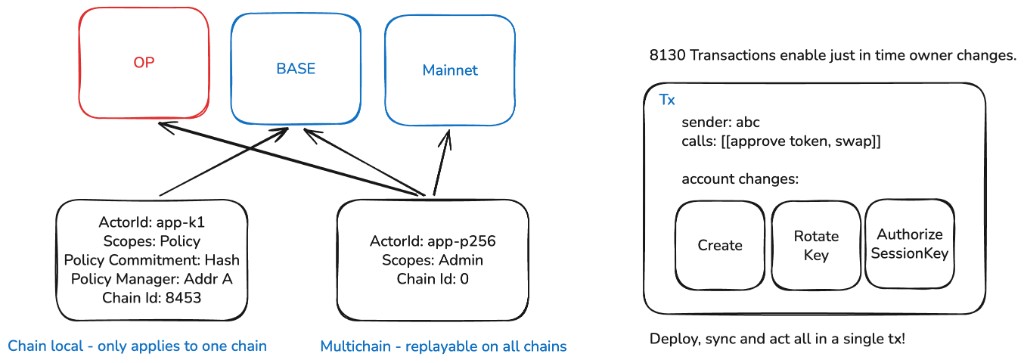
Config changes are signed state transitions batched into a SignedAccountChangeBatch entry that names an AccountChangeChannel instead of a raw chain_id: Local (0, binds block.chainid) or Multichain (1, binds chain_id 0). Two independent counters live in the packed account-state slot:
| Concept | Meaning |
|---|---|
| multichain sequence | The Multichain channel: a plain monotonic uint64 counter, no epoch. One signature is valid on every chain that has the Keystore deployed. |
| local sequence + epoch | The Local channel: the signed word packs local_epoch (high 32 bits) || local_sequence (low 32 bits). Chain-local updates; also doubles as the initialized flag (> 0). local_sequence == UNSEQUENCED (uint32 max) is an unsequenced / JIT batch: permissive, consumes no counter, replayable within its epoch. |
IncrementLocalEpoch (which may ride either channel) bumps local_epoch and resets local_sequence to 0, invalidating every unlanded local signature at the prior epoch (StaleEpoch). It does not revoke live actors or touch actor_config, so durable retirement of a JIT authorization means batching the reducing change with IncrementLocalEpoch.
One signature, many chains
An admin signs chain_id = 0 once. Relayers (or the wallet) submit the identical payload to each deployment. Each chain checks the signature against its own multichain_sequence, applies authorize/revoke operations, and increments. Nothing bridges or pushes: portability is replayable, not auto-synchronized.
// Same signed digest, two transports:

1. account_changes in an 8130 tx     → protocol applies before calls
2. applySignedAccountChanges()       → ordinary EVM call (any chain,
                                       including non-8130 / ERC-4337)
Design choices to know
- No expiry on multichain changes: intentional. A
chain_id 0update stays replayable forever, including on chains that deploy the Keystore later. Per-chain policies use the local channel (and can expire when applied). - Lock is local-only: lock / unlock are now
Lock/Unlockchanges carried inside a signed batch on theLocalchannel (each MUST be the sole, standalone change in its batch), so they bindlocal_sequenceonly. A locked chain silently rejects config changes (onlyUnlockandIncrementLocalEpochare permitted while locked) while unlocked chains accept the same multichain payload. - Sequences assume lockstep: the digest commits to a specific sequence value. Partial relay leaves lagging chains unable to accept a later update until reconciled.
- Admin only: config changes require
scope == 0x0000.
Delegation account change vs EIP-7702
EIP-7702 added authorization_list as a separate transaction-level field for pointing an EOA at shared implementation code, with ECDSA authority. 8130 folds that into account_changes:
| Concept | Meaning |
|---|---|
| 7702 today | Separate authorization_list on the tx; ECDSA authority; often a second conceptual step beside the user’s action. |
| 8130 delegation entry | Type 0x02 in account_changes: target address (or address(0) to clear). Authorized by the same sender_auth as the rest of the tx; no separate list. |
rlp([
  0x02,    // type: delegation
  target   // address to delegate to, or address(0) to clear
])- Sets
code = 0xef0100 || target(same indicator as 7702). Allowed only on empty accounts or accounts that already hold a delegation designator; never replaces non-delegation bytecode. - Authority is the native secp256k1 self-actor (EOA path or
K1_AUTHENTICATOR) with admin scope. That keeps code delegation portable: the same ECDSA authority works via standard 7702 txs on non-8130 chains. - First AA tx for a code-less EOA auto-delegates to
DEFAULT_ACCOUNT_ADDRESSif no create/delegation entry is present, so EOAs get wallet code without a prior 7702 ritual. - 8130 chains MUST support the delegation indicator even when standalone 7702 transactions are not enabled.
What this fixes in practice: install (or clear) code delegation in the same 8130 transaction as actor changes and calls: one sender_auth, no parallel authorization_list ceremony. Non-8130 chains keep using standard 7702 for the same indicator until they adopt 8130. With the EIP-7819 delegate factory, factory-created accounts get that delegation entry for every key type.
Standalone EIP-7702 transactions should also be considered for deprecation alongside 8130 adoption: they are ECDSA-only by construction and therefore not quantum-safe. Prefer the 8130 delegation account change (and, once available, authenticator-agnostic factory delegation) so code pointing rides the same scheme-agile auth path as everything else.
8130 vs non-8130 chains
| Concept | Meaning |
|---|---|
| Keystore | 8130: protocol reads storage for validation. Non-8130: same CREATE2 contract as an ERC-4337-compatible factory. |
| Authenticators | Same contracts everywhere; 8130 path STATICCALLs (or enshrines) them for mempool auth. |
| Code delegation | 8130: delegation entry in account_changes. Non-8130: standard EIP-7702 txs. |
| Multichain config | Same signed applySignedAccountChanges payload works as ordinary EVM on both. |