Protocol
Overview
The moving parts of EIP-8130 at a high level: authentication (authenticators), authorization (the Keystore), and stateful checks deferred to execution.
Big picture
EIP-8130 splits two jobs that other AA designs often fuse together:
- Authentication (authn): proving who signed. That is the job of authenticators. The transaction names the authenticator; the node runs it and recovers an actorId.
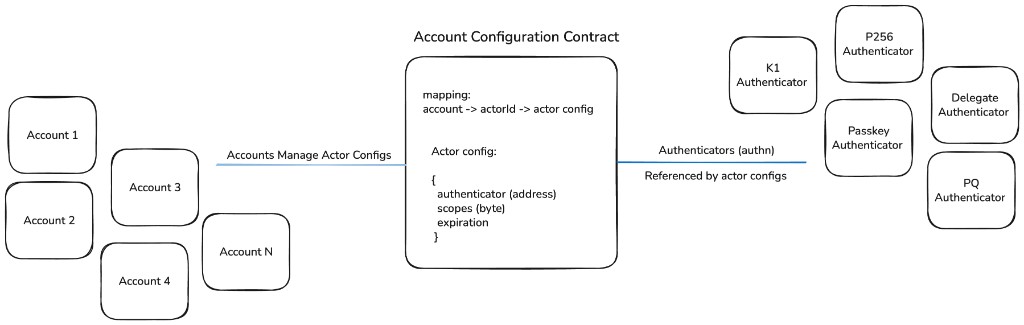
- Authorization (authz): deciding whether that actor may act, and in what role. That is the job of the Keystore: one storage slot per actor (authenticator binding, scope, expiry, optional policy metadata).
There is usually a third kind of work mixed into validation as well: stateful conditional checks (balances against app rules, allowlists, spend limits, and so on). EIP-8130 moves those to execution, often behind policies. Clear separation of authentication, authorization, and stateful checks is what keeps validation fast, optimisable, and portable.
Transaction flow
An 8130 transaction names the authenticator in the auth blob. Nodes run that authenticator, load the actor config from the Keystore (a single slot), and check authorization. The Keystore is the shared authz layer: who may act for an account, and in what role. For each account and actorId it stores a compact slot: authenticator, scope, expiry, and (when used) policy metadata.
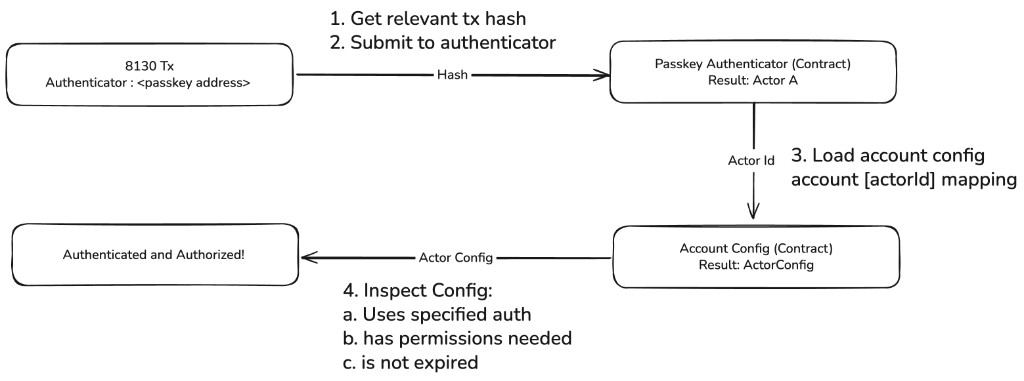
- Existing EOAs work immediately via an implicit EOA actor when the slot is empty.
- Smart accounts register or import actors without redeploying wallet code.
- The same actor state is reused for transaction auth, payers, signature checks, and config changes.
Authenticators (authn)
An authenticator recovers an actorId from signature data. That is authentication only: it does not decide what the actor is allowed to do. Authenticators typically return a hash of the public key as the actorId.
The canonical set is what the native 8130 hot path admits for transaction validation (today: K1, P-256, passkey / WebAuthn, and delegate). That set grows through a companion ERC, not by letting each wallet invent a mempool authenticator.
Non-canonical authenticators can still be installed in the Keystore and used in ordinary EVM execution, for example account recovery flows, or sentinels that reuse the signed account changes system.
| Concept | Meaning |
|---|---|
| K1 | Returns the Ethereum address (the familiar secp256k1 identity), not a generic pubkey hash. |
| P-256 | Returns a 32-byte hash of the public key. |
| Passkey | WebAuthn / passkey path; also returns a 32-byte hash of the public key. |
| Delegate | For sub-accounts: lets another account’s keys sign for this one. Nested signing on the 8130 path must still use canonical authenticators. |
Public keys are not stored in the Keystore. Key material rides in the auth blob at sign time, which keeps state small and leaves room for larger schemes later.
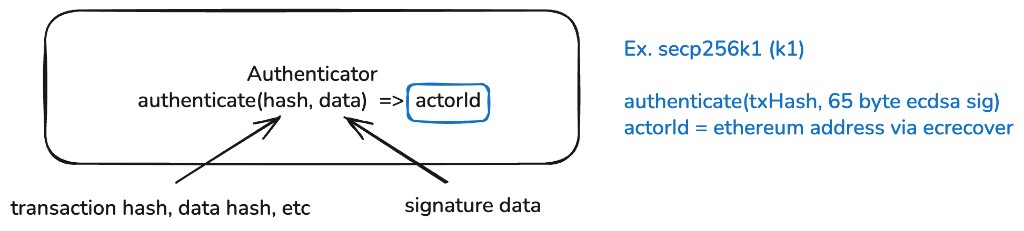
authenticate(hash, data) → actorId. For K1, that is typically ecrecover over a 65-byte ECDSA signature.Actors and scopes
An actor is an authorized key on an account. The authenticator answers “who signed?”; the scope answers “what may they do?”
| Concept | Meaning |
|---|---|
| OPERATOR · 0x01 | Originate transactions (ungated). Operational unless combined with POLICY; also covers ERC-1271. |
| POLICY · 0x08 | Originate transactions gated to a single policy_manager. |
| NONCE · 0x10 | Use sequenced nonce_keys (restricted actors; otherwise nonceless only). |
| SELF_PAYER · 0x02 | Pay the account’s own gas (self-pay). |
| SPONSOR_PAYER · 0x04 | Sponsor gas for a different sender. |
| Admin · 0x0000 | Unrestricted root: config changes, lock/unlock, and delegation. |
One account can hold several actors with different roles: a full owner (admin), a session key (POLICY), a self-pay session key, a sponsor key. That is how 8130 stays capable without putting arbitrary validation in the mempool. See Scopes, payers & phases.
Policies (session keys)
The POLICY scope bit turns an actor into a policy-gated session key. The protocol stays intentionally dumb about the policy contents:
- It stores an opaque
policy_commitment(hash of parameters). - It binds the actor to a single
policy_managertarget. - Scope carries
POLICY(never admin0x0000). Optional actor expiry.
At execution time the account forces calls to that manager; the manager enforces spend limits, allowlists, and other app rules. Rich stateful checks happen after cheap validation. More detail in Policies and session keys.

Account changes and signed config updates
Accounts evolve through account changes carried in the transaction (or applied via a portable signed path):
- Create: deploy a counterfactual account with initial actors (CREATE2 identity known up front).
- Config: authorize or revoke actors (signed owner / actor changes), including policy-gated keys.
- Delegation: install or update EIP-7702-style code delegation for EOAs moving onto smart account behavior.
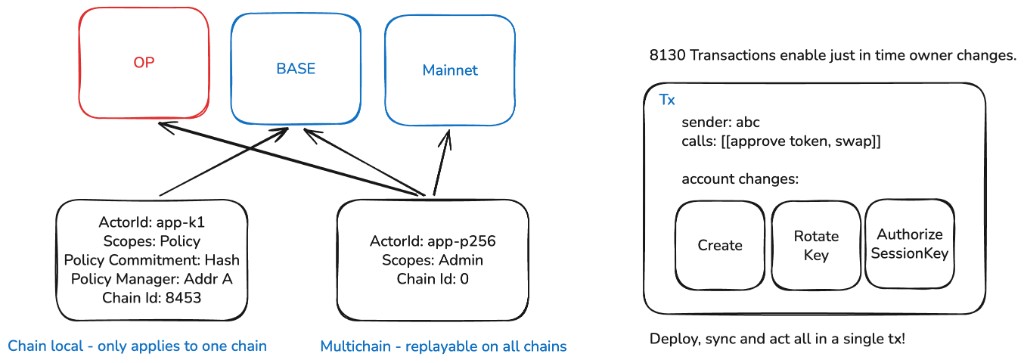
Signed account changes
Config updates are signed state transitions batched into a SignedAccountChangeBatch entry: account, change channel (Multichain for replayable updates, or Local bound to this chain), sequence, and the list of changes (authorize / revoke actors, lock / unlock, increment local epoch). The local channel packs a local_epoch in the high 32 bits of its sequence. A single admin actor (scope == 0x0000) signs the batch digest and the batch applies atomically. Sequences keep updates ordered whether they ride inside an 8130 transaction or are submitted through applySignedAccountChanges on a portable path. Depth on chain_id 0, lock locality, and delegation vs 7702: Multichain & portability.
They can also be applied just in time inside an 8130 transaction: put create / rotate / authorize entries in account_changes, then run calls in the same tx. Deploy, sync keys, and act in one shot.
Transactions in brief
A native 8130 transaction carries sender identity, 2D nonce (or nonce-free + a valid_before deadline), optional payer, account changes, call phases, and separate sender / payer auth blobs. Nodes validate auth first, then execute. Click a field below for what it does and whether it feeds validation, execution, or both.
AA_TX_TYPE || rlp([
])chain_idValidationWhich chain this tx is for (EIP-155).
Checked at admission so the envelope cannot be replayed on another chain.
Where next
From here, go deeper on how nodes admit and drop transactions (Validation, Mempool, Invalidation), or stay on the “why” track with policies and related design notes.