Protocol
Validation pipeline
Every native EIP-8130 transaction runs the same gate before wallet execution. Mempool admission and block execution share this mental model; only the surrounding checks (pending limits, lock, gas debit) differ.
The four steps
| Concept | Meaning |
|---|---|
| 1. Resolve | Determine sender (explicit sender, or recover from sender_auth) and the effective authenticator from the auth blob shape. |
| 2. Authenticate | authenticator.authenticate(hash, data) → actorId. The authenticator checks the auth data (typically a signature) against the signed hash and returns the actor’s identity. |
| 3. Authorize | SLOAD actor_config. Require authenticator match, implicit-EOA empty-slot rule, and unexpired actor. Authorize scope against the action (SENDER/POLICY, SELF_PAYER/SPONSOR_PAYER, admin, operational). |
| 4. Execute | Only after validation: apply account_changes, then run call phases. Auth failures never reach wallet logic. |
Auth blob shapes
- Implicit EOA path:
senderempty;sender_authis a bare 65-byte ECDSA(r || s || v). Cheapest path; the protocol ecrecovers the sender and resolves the inline default-EOA config. - Configured actor:
authenticator(20) || data; authenticator must be canonical on the native path. The default EOA path works here too when named explicitly (native secp256k1 authenticator + ECDSA data), with the same self-actor resolution as the bare signature form.
Sender and payer use separate signing domains so a payer signature cannot authorize sender execution. Details in Scopes, payers & phases.
Account changes during validation
Mempool validation must reason about the actor set after in-tx config changes (create / authorize / revoke / delegate), because those entries apply before calls:
- At most one create (first) and at most one delegation per tx.
- Config / delegation rejected if the account is locked.
- Simulate applying config entries in sequence; skip already-applied.
- Validate sender_auth against the resulting actor state; require SENDER or POLICY (and admin EOA-actor authority for delegation).
Policy actors at validation vs execution
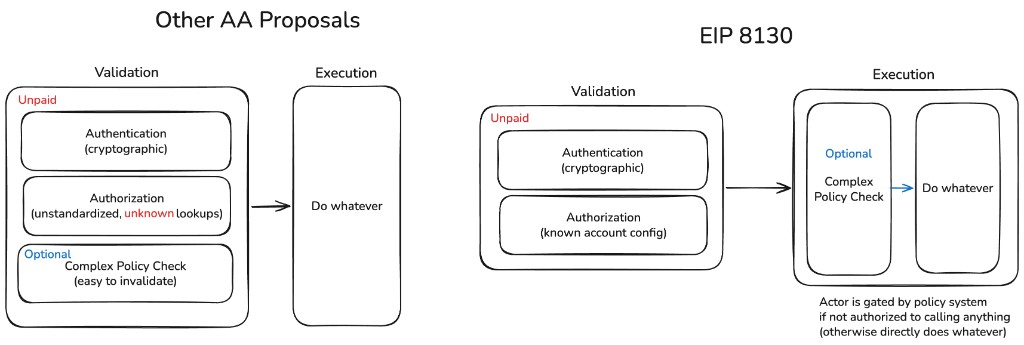
Unlike some other AA proposals, 8130 evaluates policies at execution, never at validation. This keeps validation known, bounded, and predictable: a fixed set of cheap checks, no interpreting app-defined policy logic in the mempool.
Validation
Nodes check that the actor is authorized, in-scope, and unexpired. If the actor has POLICY set, the protocol only needs to know that all calls will be gated to the actor's policy_manager: it does not interpret the policy parameters, and that gate is applied at execution time.
Execution
The account enforces call.to == policy_manager: The manager enforces the committed policy. That split is intentional. See Policies and session keys.
Native authenticator implementations
A chain fixes one of two implementation strategies under consensus, because the intrinsic-gas schedule for authenticators must agree across all nodes:
- Pure-EVM: the protocol calls the Keystore in the EVM and authenticators are metered as ordinary execution.
- Native: the canonical authenticator set (and the Keystore reads it depends on) run as native code on the 8130 tx path, priced with fixed component values.
Both produce identical results bit-for-bit. The native strategy gives deterministic gas, no interpreter overhead, and no external state deps, so it is a major throughput lever for mempool workers.